
You Don't Have to
Say Anything
the First Time.
A peer-led support group for people living with PTSD — veterans, survivors, first responders, and everyone in between.
No intake form. No insurance required. Just show up.
Question 01
What actually happens in a session?
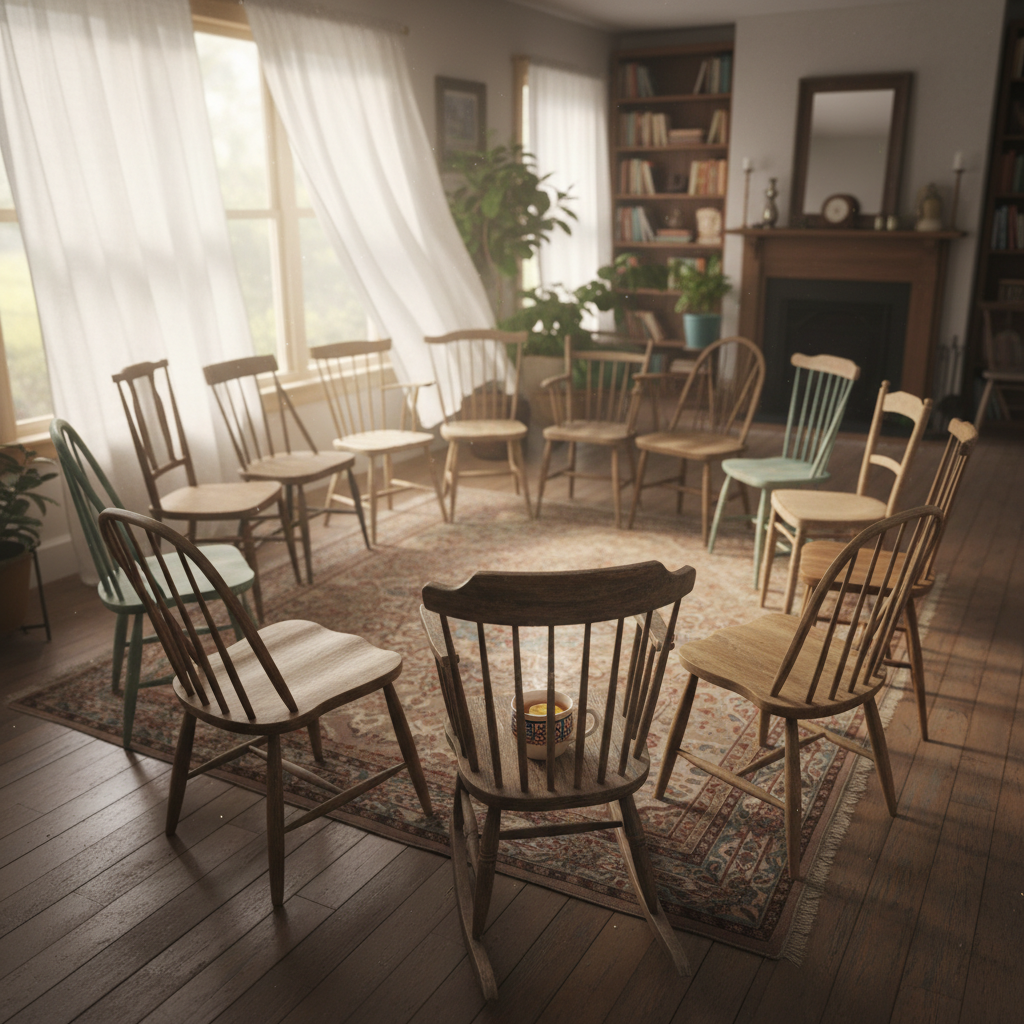
Twelve chairs. A facilitator who has lived experience with PTSD. Ninety minutes, every Thursday at 7 pm.
Sessions open with a brief grounding exercise — three slow breaths, nothing more. Then the facilitator reads the group agreements aloud. After that, whoever wants to speak, speaks. Whoever needs to sit quietly, sits quietly.
There is no agenda beyond that. No worksheets. No homework. The session closes the same way it opened — slowly, on purpose.
"I came the first week and didn't say a single word. I sat in the corner chair, closest to the door, and just listened. Nobody looked at me like that was strange. I came back the next week."
— Group member, 14 months
"My therapist referred me. I told her I wasn't ready to talk about it. She said that was fine — that listening was its own kind of work."
— Assault survivor, joined after 3 years of individual therapy
Group Agreement
What is shared in this room stays in this room.
No advice unless it is asked for.
No one has to explain themselves.
Question 02
Will I have to talk about what happened?
No. Not once. Not ever, unless you decide you want to.
This group is not exposure therapy. It is not a place where you will be asked to revisit your trauma, walk through a timeline, or explain your symptoms to strangers.
People come here because they are tired of carrying something alone. Some of them talk. Some of them listen. Some of them just needed a room full of people who understand — without anyone having to say a word.
The only rule is that you don't pressure anyone else to share, either. That goes for everyone, including the facilitator.
If you're a therapist looking for a referral resource for a client who is ready for peer support, you can download our clinical overview PDF or reach us directly.
Question 03
What if I panic or fall apart?
Then you panic or fall apart, and the people in the room have probably been there themselves.
The facilitator is trained in trauma-informed grounding techniques. The room is set up so the door is always visible and never blocked. You can step outside at any time — before, during, or after — without explanation.
We ask that you let us know in your RSVP if there's anything that helps you feel safer — a specific seat, a co-regulator nearby, knowing where the bathroom is before the session starts. We'll have it ready.
Question 04 · Is this a replacement for therapy?
No. Anchor is a peer support group, not a clinical service. Many members attend alongside individual therapy. Some come here first and find their way to therapy through the connections they make. We keep a list of trauma-informed therapists in the area and can share it on request — no pressure either way.
A grounding technique we use
The 5-4-3-2-1 method. It takes about two minutes and works anywhere — a waiting room, a car, a circle of chairs.
things you can see right now
things you can physically feel
things you can hear
things you can smell
thing you can taste
We open every session with a version of this. By the third week, most members can do it with their eyes closed.
The door is always open
Reserve Your Spot
Save a Chair
We hold a chair for you when you RSVP — no deposit, no commitment to return. Just a name so the facilitator can say hello when you walk in.
What to Expect Your First Time
A quiet PDF guide · 4 pages
Where to park. What the room looks like. What the first ten minutes feel like. Written by a former first-time attendee who wished they'd had it.
When & Where
Every Thursday · 7:00 – 8:30 pm
The Linden Community Center
Room 14, 2nd Floor
Portland, OR 97201
Facilitated By
Dana K., a combat medic veteran and certified peer support specialist with 6 years of facilitation experience. Dana has lived experience with PTSD.
Questions?
Text us at (503) 421-0099 or email hello@anchorpdx.org. We respond within 24 hours.